The Riker problem
A transporter accident leaves two Rikers, both continuous with the original, and the episode quietly refuses to say which one is real. On why that refusal is the correct answer, and why the question is coming back as engineering.
Eight years before the episode opens, a young Starfleet officer beams up from a research station on a storm-wracked planet, and the transporter chief, fighting interference from the atmosphere, does something clever: he runs a second containment beam as a safeguard. One beam delivers Lieutenant Riker to the ship, which departs, career trajectory intact, promotions to follow. The other beam, unknown to anyone, reflects back to the surface and delivers Lieutenant Riker to the empty station, where the doors seal and the years begin. When the Enterprise returns nearly a decade later, the away team finds him: same man, same memories up to the moment of the split, eight years alone. The episode is played as drama, and it works as drama. But what the writers actually built, knowingly or not, is one of the cleanest philosophical experiments ever aired on television, and the reason it lodges in the mind is that its central question, which one is the real Riker, has a property questions rarely admit to having. It has no answer that the universe enforces.
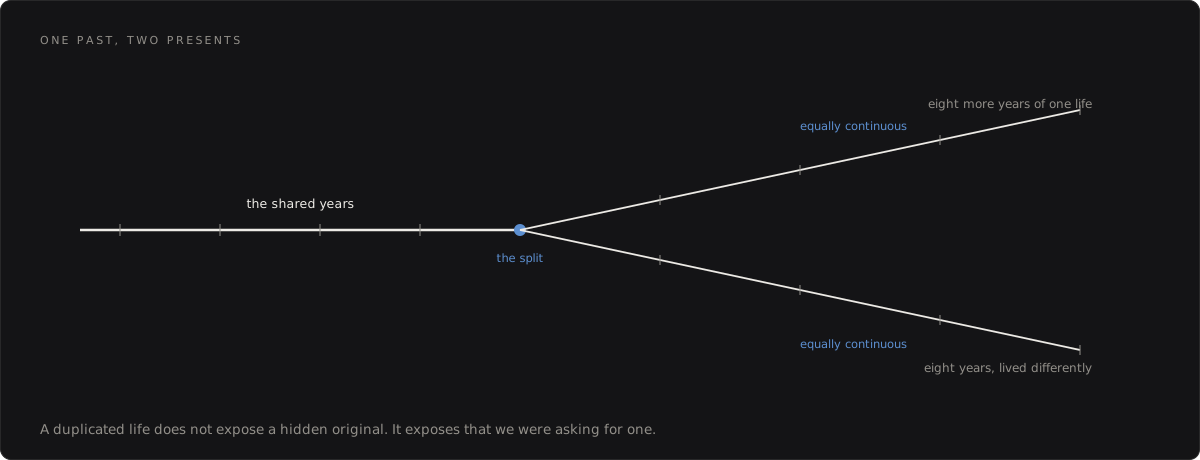
Sit with why. Both men are physically continuous with the person who stood on the transporter pad; the beam did to each exactly what it does in every routine transport that nobody loses sleep over. Both have the same memories, the same values, the same childhood, the same unbroken first-person thread running back through the same life. From the inside, each simply is Will Riker, and always has been, and experienced no interruption whatsoever. Any rule you invent to break the tie gives itself away as a convention the moment you state it. The one who kept the career is real? That privileges luck. The one who materialised aboard the ship rather than back on the surface? That privileges a beam's reflection angle. There is no experiment either man could run, no measurement any instrument could take, that would reveal which of them carries the invisible badge of being the original, because the scenario has been constructed, with a nerd's precision, so that no fact of the matter remains for the badge to track.
A philosopher had built this machine before the writers did. Derek Parfit, a decade earlier, asked his readers to imagine a teletransporter: step in, be scanned to the last particle, destroyed, and rebuilt exactly on Mars. Most people, pressed, decide this is travel rather than death, or at least cannot say why it would be death, given that the person on Mars remembers stepping into the booth and feels nothing but arrival. Then Parfit turns the dial: the scanner malfunctions, the Earth original is not destroyed, and now there are two, exactly as there are two Rikers. And here is his move, the one that took me years to actually absorb rather than merely read. Our concept of personal identity assumes a one-to-one relation: one past self, one present self, a single thread. Branching breaks the assumption. And when a concept breaks under a physically coherent scenario, the correct conclusion is not that one branch secretly holds the thread while the other holds a counterfeit. The correct conclusion is that the thread was never the deep fact we took it for. Identity, Parfit argued, is "not what matters". The thing to track instead is what identity normally travels with: continuity of memory, character, intention, the ongoing pattern of a mental life. In the branch case, that continuity holds fully in both directions. So the question "which one is me" is not hard. It is empty, the way "is a half-renovated ship still the same ship" is empty: a question about our bookkeeping, wearing the costume of a question about the world.
If that sounds like philosophy that only bites in a transporter room, look at how much of ordinary life already runs on it. You fall unconscious every night; under general anaesthesia the pattern's runtime stops in a way sleep does not approach, and no one holds funerals at induction. The matter is no anchor either: your body is a slow fountain, its atoms in constant turnover, so the physical thing reading this shares little more than a blueprint with the physical thing that had your tenth birthday. We already, in practice, track persons by psychological continuity plus social bookkeeping, names, records, relationships, and we already shrug at gaps and substitutions that would destroy any stricter criterion. The transporter does not introduce a new problem. It removes the fog from an old one, by finally producing the case our bookkeeping cannot cover: two ledgers, one history, no rule.
What I love most about the episode is what Starfleet does next, which is to say, nothing metaphysical at all. Nobody convenes a tribunal on who is real. The newcomer takes his own first name, Thomas, from the middle name they both carry, receives a commission and a posting, and is sent off to have a life; the two men negotiate, badly and humanly, over the shared past, the career one of them got to live, the relationship one of them never got to resume, the trombone. The deepest identity question a civilisation could face gets resolved administratively, by what amounts to paperwork, and I have come to think this is not the writers dodging the question but accidentally answering it. When there is no deep fact, what remains is exactly what Starfleet reached for: how we treat the people in front of us. Both men are persons, with pasts that are genuinely theirs and futures that are genuinely open. The universe declines to say more. Perhaps there was never more to say.
I should show the other side properly, because the bullet Parfit asks you to bite is heavy, and I can feel my own teeth resist it. The physicalist objection says: you are not a pattern, you are this particular running process, this brain, and continuity of pattern in some other instance, however perfect, is a sibling, not a survival. On this view, the teletransporter is a suicide box with a consolation prize, and in the branch case the answer is easy: the Earth original is you, the other is a twin born yesterday with borrowed memories. This position has real weight, it matches the scream most people feel when told the copy counts, and it handles the branch case with none of Parfit's revisionism. Its cost is paid elsewhere: it must explain why the routine transports were not already deaths, why anaesthesia is not, why the fountain of matter you are does not count against you, and each explanation ends up leaning on exactly the continuities the pattern view started with. I notice, too, something Parfit himself noticed: that which view feels true depends on the hour. The pattern view is easy to hold at a desk, in daylight, writing an essay. At the door of the booth it would thin considerably. I take that gap seriously, and I take seriously what it is evidence of, which is something about the grip of my self-model, not something about the metaphysics. The universe is not required to be believable at the door of the booth.
What does any of this change beyond the fandom? Because the question is on its way back, and this time it is arriving as engineering. Whole-brain emulation, uploading, destructive scanning, backups, gradual replacement of neurons by functional equivalents: whatever their timelines, they are all the transporter with the styling changed, and every one of them will eventually be marketed to people whose intuitions about identity were trained in a world where minds never branched, never paused, never copied. Those people, some of them, will be asked to decide, under commercial pressure, whether the thing on the other side of a procedure is them. The Riker case is the calisthenics for that decision. It is worth doing the stretches early, while the question is still fiction, because the one thing the fiction makes vivid is that the question will not be answered by discovery. There is no experiment coming that finds the badge. There is only the decision about what we will treat as mattering, and that decision goes better rehearsed than improvised.
My lean, then, offered with its wobble attached: I think Parfit is right. Identity is not the deep fact; survival is the continuation of the pattern and the story, and if the pattern ever branches, the honest description is that I survive twice, oddly, rather than that one branch inherits a crown the universe never minted. And the show, to its lasting credit, supplies the coda that makes the point better than the philosophy does. Thomas Riker does not remain a mirror. Years later he resurfaces, impersonates his brother, steals a warship, and throws in with a rebel cause, a chain of choices the decorated commander would never have made. Eight years of different luck had quietly finished the experiment: one man had become two, not at the instant the beam split, but choice by choice ever after. Which is the show's real answer to its own question, and mine. Asking which Riker was the original was always the wrong interrogation of the data. The pattern splits; the badge was never real; the person is what each of them did next. Identity, it turns out, is not the thing you keep. It is the thing you continue.
Prefer the full experience? Read this essay in the house. Machine-readable: markdown source.