The disease with a fan club
Propose curing the condition that kills more people than everything else combined, and watch educated people defend the condition. On ageing, the case for treating it, and why the objections deserve better answers than either side usually gives.

There is exactly one fatal condition you can propose to cure in educated company and reliably watch the company defend the condition. Propose curing cancer and everyone nods; propose ending dementia and you are a hero. Propose treating ageing itself, the process upstream of both, and the room turns philosophical on you. Hubris, someone says. Unnatural. Wouldn't you get bored? Think of the dictators, the pensions, the crowding. People who would trade anything for one more good year with a specific dying parent will argue, in the abstract, with real feeling, for the process that is scheduled to kill everyone they love. Ageing is the only disease with a fan club, and I want to take the fans seriously, because a few of their arguments are better than my side usually admits, and because the way a claim survives its best objections tells you more than the claim ever does.
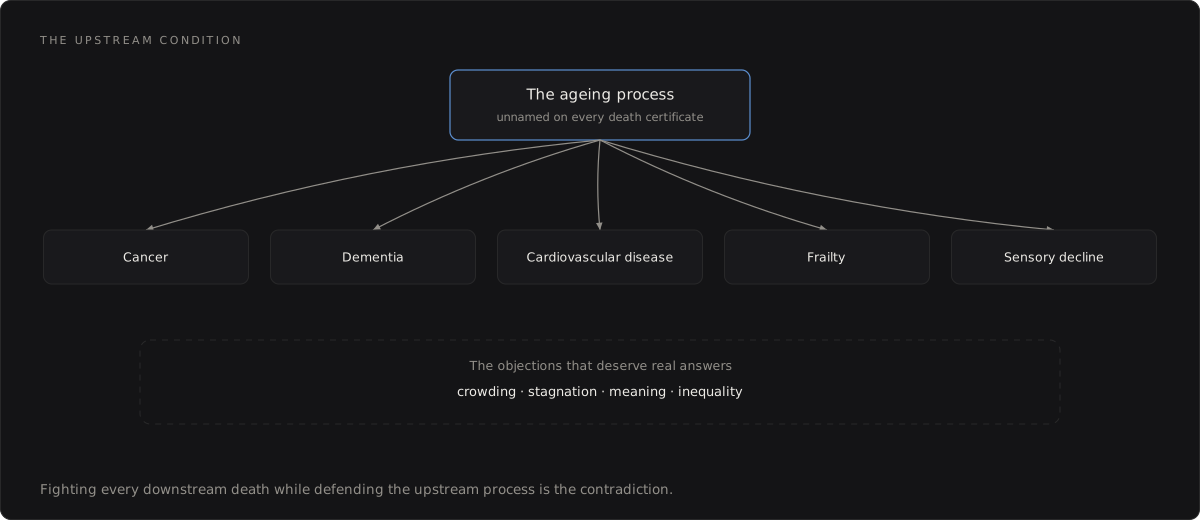
First, the claim itself, stated precisely, because the sloppy version deserves the mockery it gets. The claim is not that anyone has a cure, or that immortality is around the corner, or that death will be optional by Tuesday. The claim is narrower and harder to dismiss. Ageing is not a mystical destiny; it is a set of physical processes. Damage accumulates, repair declines, and the specific mechanisms are being mapped with increasing resolution. Processes with mechanisms are, in principle, tractable. And wanting to slow or repair those processes is not a departure from medicine; it is continuous with everything medicine already does. A statin is a small rebellion against the ageing of arteries. A cataract operation un-ages an eye. Nobody calls blood pressure treatment hubris, yet its entire purpose is to postpone death from a process that used to be called natural causes. The research program says only this: rather than fighting the downstream diseases one organ at a time, go after the upstream process they share. That is the whole heresy.
Before the objections, one test, because it exposes the shape of the intuition we are dealing with. A pair of Oxford philosophers proposed it years ago. Suppose human lifespan were naturally a hundred and fifty years, and someone proposed engineering it down to eighty, for the sake of meaning, social turnover and the pension system. We would call that person a monster, and we would be right. But if eighty is good and a hundred and fifty would be bad, there must be something special about the current number beyond the fact that it is the one we happen to have. If no such reason exists, the preference for the current number is not wisdom. It is anchoring, the status quo dressed in robes. Hold that test in mind, because most of the objections walk straight into it.
Now the fan club's arguments, in ascending order of strength, each given its honest due.
The oldest is the Tithonus problem, named for the myth: a goddess asks that her lover live forever and forgets to ask that he stay young, and he withers, endlessly, into something that can only beg for the death he cannot have. The modern version is the fear that life extension means extending the last decade, frailty stretched thin across extra years, more time in exactly the condition nobody wants more time in. This fear is entirely legitimate, and it is an argument about the target, not the mission. Nobody serious is trying to extend frailty; frailty is the thing being targeted. The mechanisms that produce the miserable final decade are the mechanisms of ageing itself, which is why the research aims at healthspan, the years lived in good function, with lifespan following as a consequence rather than a goal. Tithonus is a warning label on bad longevity. He is not an argument against the good kind, any more than a botched operation is an argument against surgery.
Stronger is the meaning objection, the philosopher's favourite: that death is what gives life its shape, that meaning requires a deadline, that an endless life would drain into boredom and indifference. The classic version was built by the philosopher Bernard Williams around an opera character, three hundred and forty-two years old, who has exhausted her reasons and chooses to stop. I take this one seriously, because some structure really does come from limits. But notice three things. First, look at where meaning actually lives in a human life: in people, projects, curiosity, craft. None of it is obviously priced by scarcity. Nobody loves their child harder because of actuarial tables, and no one has ever put down a fascinating problem because they calculated they had time for it. Second, we do not behave as if we believe the objection. Every extension already achieved, the antibiotics, the vaccines, the doubling of average lifespan in a century and a half, was accepted without a meaning crisis, and nobody argues that dying at sixty was more meaningful than dying at eighty. The finitude argument is only ever deployed against futures, never against the presents that previous futures became. Third, and decisively for me: the opera character chooses to stop, and the choice is the point. The proposal on the table is more life as an option, not conscription into it. If endless decades genuinely hollowed a particular person out, declining further extension would remain exactly that: a choice about treatment, of the kind medicine already respects every day. An argument that some people would eventually decline the option is not an argument against the option existing. Still, I will concede what the objection gets right: a very long life would demand something from us, new arts of renewal and reinvention that a short life never had to develop. That is a real cost. It sits on the ledger. It does not close the ledger.
Then the political objections, which are stronger than the philosophical ones, and I say that as someone on the pro side. Inequality first: the rich will get it before everyone else, and the spectre of immortal oligarchs is genuinely ugly. Two replies, neither of which fully dissolves it. Every medical advance in history debuted expensive and unequal, and the trajectory of the important ones has been the same arc from luxury to standard of care; the antibiotics and antivirals that were once rationed by wealth are now generic. And more fundamentally: unequal access to a good has never been accepted, anywhere else in medicine, as a reason the good should not exist. We do not ban treatments because they roll out unevenly; we fight about distribution. The fix for the ugly transition is politics, and I will not pretend the politics would be easy, because a decades-long window in which the wealthy visibly age slower than everyone else is about as socially flammable as a technology can be. That window is a real danger. It is a reason to plan the distribution hard, not a reason to prefer that everyone keep dying on schedule, which is what the objection amounts to if you say it slowly.
The objection that worries me most is turnover. Science, the saying goes, advances one funeral at a time; institutions calcify around their incumbents; and death has quietly served as history's term limit, the one mechanism that reliably removes tyrants, unseats orthodoxies and hands the world to people with newer ideas. A world of very long lives could be a world of very long grips on power. I find this genuinely troubling, because unlike the others it is structural. But look at what the argument actually assumes: that the only way to achieve turnover is for the powerful to die. We already know that is false, because we already build turnover deliberately, with term limits, mandatory retirements, succession rules, elections. We have simply been lazy about it, because biology did the job for free. A long-lived civilisation would need institutional turnover designed on purpose, everywhere that death currently provides it by default, and that is a large, real cost of the project that its enthusiasts should carry openly. I will also admit the grim comfort in the current arrangement: waiting out a tyrant's arteries has occasionally worked. As a civilisational plan, though, "we rely on our leaders' cells failing" is the kind of sentence that sounds like wisdom only because we have never had an alternative.
Overpopulation, finally, because someone always brings the arithmetic. The arithmetic deserves a calm look rather than a shudder. Population level is dominated by birth rates, not death rates, on any timescale longer than a generation, and the demographic story of this century is fertility falling below replacement across most of the developed world, with the rest following as prosperity spreads. Longer lives arriving gradually into a world of falling birth rates is a curve to be managed, not an explosion, and it is worth noticing that half the wealthy world currently panics about the opposite problem. Long-run questions about resources are real and belong to the same category as every other long-run question a growing civilisation faces. They are rate problems. Rate problems have policies.
One paragraph I want to place carefully. For many people, mortality sits inside a religious account of existence, one in which death is not an ending and acceptance is not resignation. Nothing in this essay is aimed at that consolation, and I would think poorly of a version of it that was. My argument is with the secular forms of the objections, which circulate freely among people who hold no such account and who defend the current lifespan with borrowed serenity, as if the number were chosen. It was not chosen. That is the whole point.
So, my lean, plainly and with its costs attached. I support this research, funded seriously, pursued in the open, for a reason that is almost boring: the current human lifespan is not a decision anyone made. It is the residue of evolutionary trade-offs that optimised for reproduction on a savannah, and being at the mercy of an unchosen default is not a value, however many centuries of poetry we have written to make peace with it. Nearly everything we call wisdom about mortality was composed under duress, by people who had no alternative; acceptance was the only prescription available, so we made a virtue of it, the way a species would. I do not ask anyone to want three hundred years. I ask them to notice the difference between declining an option and defending a default, because only one of those is a choice. More life should be something a person can turn down. The first generation that can actually turn it down will, I suspect, read our elegies for limitation the way we read old defences of other unchosen sufferings: with sympathy, and some bafflement. I would like, ideally, to be around to be embarrassed by this essay. That is rather the point of it.
Prefer the full experience? Read this essay in the house. Machine-readable: markdown source.