The Federation doesn't pay you
Star Trek asks you to believe in warp drives and telepaths, and neither is the show's most radical claim. The most radical claim is that nobody aboard is paid, and that this made humanity better instead of worse.
Star Trek asks its audience to accept faster-than-light travel, telepathic aliens, matter transporters and a universal translator that never once glitches for drama, and none of those is the show's most radical proposition. Physics gets a pass in science fiction; sociology doesn't. The genuinely radical claim, the one hiding in plain sight across decades of television, is this: nobody on the Enterprise is paid. There's no money. Nobody's rent depends on the away mission. And the show's quiet, enormous wager is that people got better under those conditions, not worse.
The mechanism, in-universe, is the replicator: matter arranged on demand, which functionally ends material scarcity. Food, clothing, tools, the violin Data plays: conjured, not purchased. And once you can conjure things, the economic logic that has organised every human society since agriculture simply loses its subject matter. As Picard explains, more than once, with the patience of a man briefing time travellers: the economics of the future are somewhat different, humanity outgrew the accumulation of things, and people now work to better themselves and the rest of their species. It's delivered as gentle exposition. It is, if you sit with it, the single most utopian sentence in the franchise, warp drive included, because warp drive only bends spacetime. That sentence bends us.
To its immense credit, the franchise's best writing knows how big the claim is and keeps interrogating it. The Ferengi exist as a walking control group: a species built entirely from the profit motive, played for laughs, whose joke lands because they are transparently us, twentieth-century economics wearing prosthetic ears, wandering through paradise asking what everything costs. It's telling that the writers had to invent latinum, a substance replicators can't reproduce, just so the Ferengi could have something to want; scarcity had to be smuggled back into the universe by hand, because drama, like economics, runs on it. And the franchise's sharpest hour on the subject is barely about money at all: a Starfleet officer, radicalised on the neglected frontier, spits that it's easy to be a saint in paradise, and the show, remarkably, lets the accusation stand. Utopia at the core, it concedes, is subsidised by rougher arithmetic at the edges. Paradise has a supply chain. That's not a plot hole. That's the most honest thing Star Trek ever said about itself.
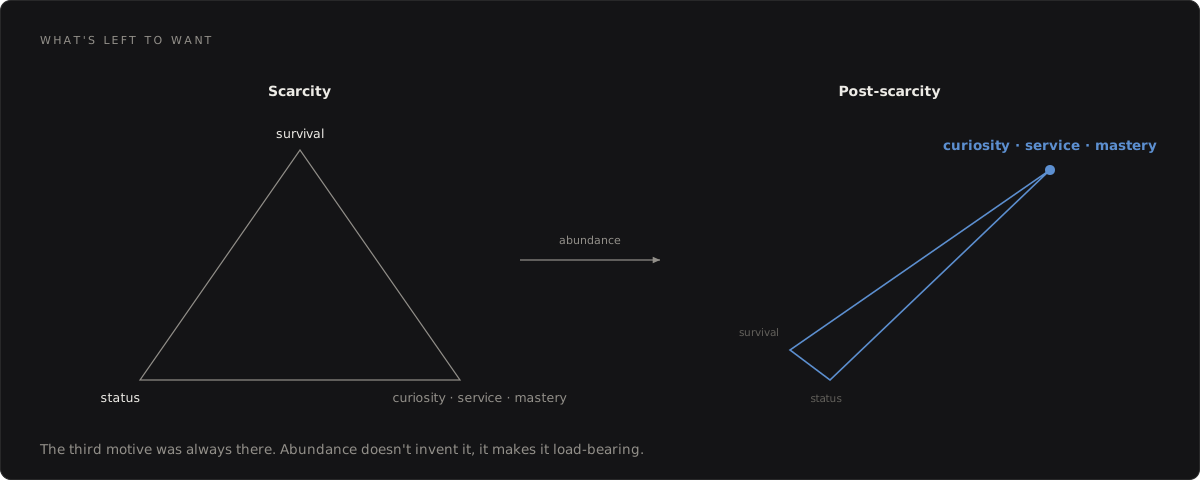
But the deep question the Federation smuggles into your living room is the one that outlasts the episode: what do people do when nothing is required of them? Every civilisation so far has answered "whatever survival demands" and built its meaning, its status and its mornings around that demand. Remove it, and the standing fear, the one you'll hear within ninety seconds of raising this topic at any barbecue, is collapse: purposelessness, softness, a species of couch. Star Trek's answer is the opposite, and it's specific: people do more. Starfleet is oversubscribed. Characters compete ferociously, their whole lives, for the privilege of working brutally hard for zero pay in conditions of frequent mortal peril. Mastery, exploration, service and reputation don't just survive the death of the wage; they annex the territory it vacated.
Is that plausible? Here's where it stops being fan trivia, because we actually have evidence, and it points both ways at once. On the Federation's side: essentially everything great ever built by people who didn't need to. Open-source software running the world's infrastructure, written free by people with day jobs. The largest encyclopedia in history, donated. Amateur astronomers, volunteer rescue crews, every retiree working harder at sixty-eight than they did at forty-five, and, closer to home, every workbench like mine, where the hardest and most satisfying labour I do is precisely the labour nobody pays for. Secure people, given a floor, don't reliably stop. They redirect. But the prosecution has exhibits too, and honesty requires displaying them: the infinite scroll, engineered to be exactly what a demand-free hour collapses into; the well-documented misery of some who inherit freedom-from-necessity without ever building anything to point it at. The variable, as far as I can tell, isn't human nature, which shows up on both sides of the ledger. The variable is culture: whether a civilisation has built sources of purpose, status and structure that don't route through a wage. The Federation's utopia isn't really running on replicators. It's running on an education system and a shared story we never see built, doing colossal, invisible work.
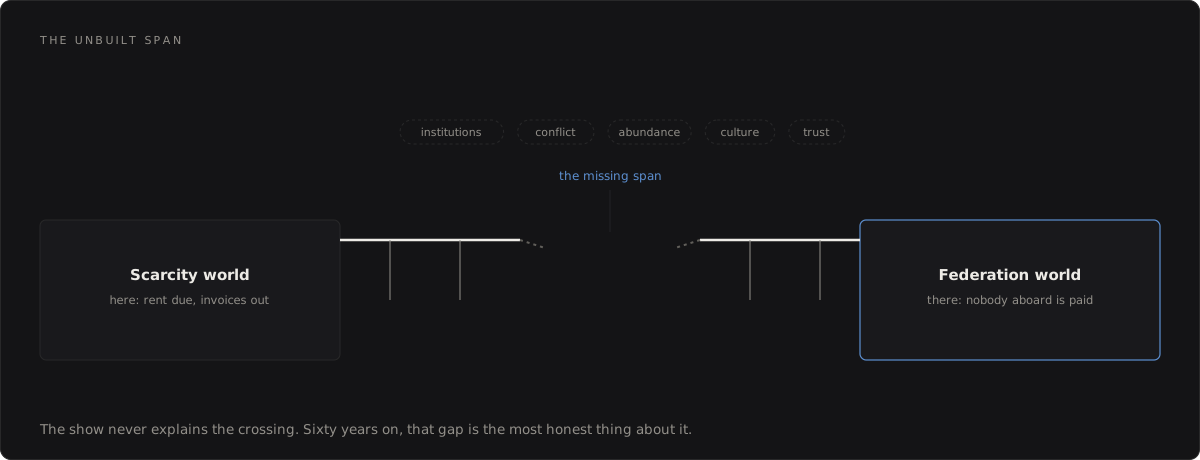
And that's the cheat, the one place the great thought experiment flinches. Star Trek never shows the transition. Between our world and Picard's sits a third world war, a collapse, and a convenient alien handshake in the rubble: the writers skipping the hard part, which is the tell, because the hard part is the actual problem. It's a problem with a schedule now. The automation of labour has stopped being a thought experiment; I work in the building where it's being poured, and the question of what a society does when machine output decouples income from work is arriving whether or not anyone's prepared a syllabus. I'll state my lean plainly and hold it loosely, as ever: I think something in the family of a universal income becomes less a policy choice than an eventual accounting identity, the strongest argument against is real and it's the one above, that a floor without a culture of purpose can hollow people rather than free them, and the strongest counter to that is that we've never once run the experiment with the abundance actually shared, so every confident prediction, mine included, is extrapolation from a world we're about to leave. The economics may end up the easy half. Trek's real prediction was always cultural: that we could build people who, handed everything, reach for more rather than less. Nothing about that happens automatically. It would have to be built, deliberately, and the construction has not started.
The Federation doesn't pay you, and the show's quiet claim is that this was the moment humanity finally got good: that we were always better than our incentives, and merely waiting for the invoice to stop arriving. I honestly don't know if that's prophecy or wish. What I know is that across seventy-odd years of televised futures, nearly all of them rubble and rain, it remains almost the only mainstream one in which abundance made us larger. That the optimistic scenario is the outlier says nothing about economics and something quite loud about us. Worth noticing, before the replicators ship.
Prefer the full experience? Read this essay in the house. Machine-readable: markdown source.