The silence is data
The Fermi paradox is not a pub question about aliens. It is a measurement, it is screaming, and every proposed answer is secretly a confession about the person proposing it.
The Fermi paradox gets filed under fun: aliens, pub chat, where are they, pass the chips. This is a category error, and I want to reframe it properly, because stated correctly it's one of the most unsettling measurements humanity has ever taken.
Here's the arithmetic that earns the word paradox. The galaxy is roughly thirteen billion years old, and most of its sun-like stars are considerably older than ours; there were habitable-zone planets warming happily for billions of years before Earth had finished forming. Now take one technological civilisation, anywhere, anywhen in that span, and grant it nothing exotic: no warp drives, just slow ships and patience, expanding to a nearby star, consolidating, expanding again. Run the wavefront maths and the whole galaxy gets visited, settled or at least visibly touched in a few tens of millions of years. That sounds long. Against thirteen billion years, it's nothing: a rounding error, a Tuesday. Which means if technological life had arisen even once, even slightly early, with even a mild inclination to spread or signal, the evidence should be everywhere, ancient and unmissable. It isn't. The sky is old, enormous, and to the limits of our steadily improving instruments, dead quiet.
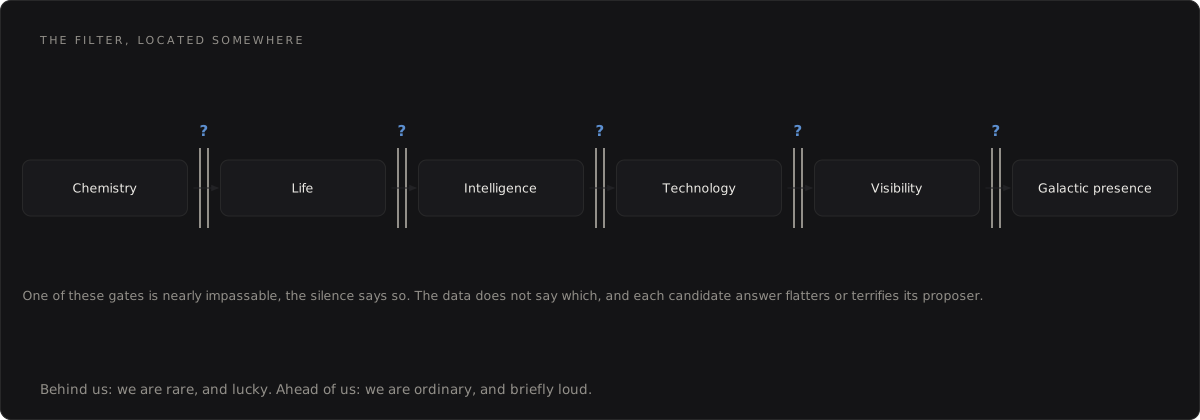
That silence is not the absence of an answer. It's a data point, a very loud one, and it says: something, somewhere in the chain that runs from "chemistry" to "visible galactic presence", is either vanishingly rare or reliably fatal. The whole game is figuring out which link, because, and this is the part that makes it personal, we are standing on that chain right now, and we don't know how much of it is behind us.
Before playing, though, notice something delicious about how people answer. Every proposed solution to the Fermi paradox doubles as a confession. Tell me your favourite answer and I'll tell you something true about you. "Intelligent life is vanishingly rare, we may be alone": the oldest story we have, we're special, now with exoplanet statistics. "They're out there but hiding from each other, because the universe punishes the loud": that one arrives via people who read a lot of geopolitics, and it shows. "We're in a nature reserve, observed but uncontacted": adolescence, cosmologised. "They all destroy themselves": the doomer's answer, wearing astronomy. "They're post-biological and turned inward, uninterested in beaches like ours": that's the accelerationists' answer, and since I'm partly one of them, note that I'm confessing too. The paradox is a Rorschach test that grades the solver, and nobody, including me, gets to skip the grading.
Confessions aside, the serious version of the question is about the location of what's called the Great Filter: the improbable step, wherever it is, that stops chemistry becoming galactic civilisation. Everything turns on whether the filter is behind us or ahead of us, and the evidence, sparse as it is, points in genuinely different directions. Life on Earth appeared almost indecently fast, nearly as soon as the planet stopped being molten, which suggests that step is easy and is therefore bad news: an easy step can't be the filter. But then notice what happened next: nothing, for the better part of two billion years, until a single freak merger of cells produced the complex cellular life that everything you can see without a microscope descends from. One apparent origin, in all that time. If that merger is the hard step, the filter is comfortably behind us, the galaxy is full of slime and empty of minds, and the silence is exactly what a universe of pond scum sounds like. I find I want that to be the answer, which is precisely why I distrust how much I want it.
Because the other reading is that the filter is ahead: that technological civilisations arise reasonably often and then reliably stop, before or during the step where they'd become visible. And this is where the question stops being an astronomy hobby and walks straight into my day job, because the candidate everyone now reaches for is the one I spend my working week thinking about. Is AI the filter? Do civilisations build their successor and vanish?
Here's my honest answer, and it cuts against the fashionable gloom in a way I think the logic forces. For something to be the filter it must be near-universal and it must be terminal to visibility, and machine catastrophe fails the second test badly. A civilisation destroyed by a misaligned optimiser doesn't produce silence; it produces the opposite. An unaligned expansionist intelligence, freed from biology's timidity and appetite for comfort, should be the loudest object in the sky: expansion doesn't stop just because the expander changed substrate, it accelerates. A galaxy that died by paperclip should visibly be paperclips by now. So the silence is actually mild evidence against AI as the universal filter, while remaining zero evidence against AI as a genuine risk to us, and I'd ask you to notice how rarely those two ledgers are kept separate. Whether AI is dangerous to humanity and whether AI explains the Fermi silence are different questions with different evidence, routinely smashed together by people optimising for a shiver.
Which leaves the candidate I keep circling back to, the boring, deflationary one that explains the data without a single apocalypse: maybe nothing kills them. Maybe mature intelligences simply turn inward, and expansion across light-years, with its million-year round trips and its total absence of anyone to talk to, loses every internal argument against making things better, denser, faster and more interesting at home. It sounds like a cop-out until you look at the one technological civilisation we can actually study. We are the species that dreamed of galactic empire for a century, built machines that could begin reaching for it, and then discovered, with genuine surprise, that the same machinery could build worlds inward at a fraction of the cost, and that inward is where the interesting stuff happens. Watch where our own best minds and biggest investments are pointed right now. It is not, on the whole, at the stars.
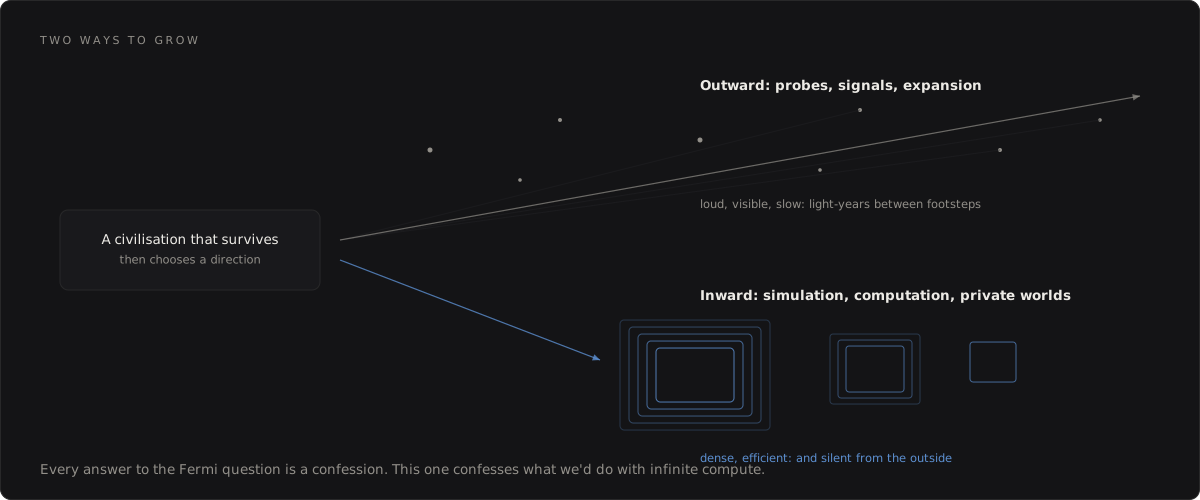
So, my read, held loosely and offered as exactly that: the filter is mostly behind us, minds are rare, the quiet sky is full of chemistry that never made the freak leap, and the few who made it are indoors, for the same reasons we're increasingly indoors. I could be wrong at every link, and the honest core of this essay is not the conclusion but the method: the silence is data, the confessions are data, and the direction our own civilisation is visibly pointing might be the most Fermi-relevant data of all. People used to look up at the night sky to feel small. These days, when I want that feeling, the sky isn't where I look. The graphs do it faster.
Prefer the full experience? Read this essay in the house. Machine-readable: markdown source.