Addiction, minus the morality tale
Addiction is the last common condition we still treat as a character flaw. What it actually is, why willpower alone fails, and what treatment in general practice really looks like.

There is no other common medical condition where the standard community response is blame. Nobody is told to pull themselves together out of asthma. But addiction, one of the most prevalent and most treatable conditions in the country, still gets discussed, and too often treated, as a failure of character. That framing is not just unkind. It is clinically wrong, and it keeps people out of the very consulting rooms where the useful help lives. So here is the version of addiction I actually work from.
Addiction is a learned change in the brain's motivation system. Every addictive substance and behaviour, from alcohol and nicotine to opioids, stimulants and gambling, works on the same underlying circuitry: the dopamine system that tags things as important and worth repeating. With repeated exposure, the brain adapts. It comes to expect the substance, recalibrates around it, and wires the surrounding cues, the time of day, the stress, the place, the feeling, into powerful triggers. Two things follow that explain almost everything people find baffling about addiction. First, tolerance and withdrawal: the same amount does less, and stopping produces genuine physical and psychological distress, because the brain is now operating on the assumption of supply. Second, and less well understood, wanting detaches from liking. Many people with long-standing addiction do not particularly enjoy the substance anymore. The craving persists anyway, because the system that drives seeking is not the system that generates pleasure. When someone says "I don't even like it and I can't stop", they are not being weak. They are giving a textbook description of the neurobiology.
This is why "just stop" fails as a treatment plan. It asks the person to out-argue a system that was specifically retrained, over months or years, to override argument. Willpower is real, and in my experience people with addiction spend more of it in an ordinary day than the people judging them spend in a week. But willpower is a finite, fluctuating resource being asked to hold a line continuously, against a trigger network that never clocks off, and it only has to fail once per day to lose. Good treatment does not demand a stronger fighter. It changes the terms of the fight.
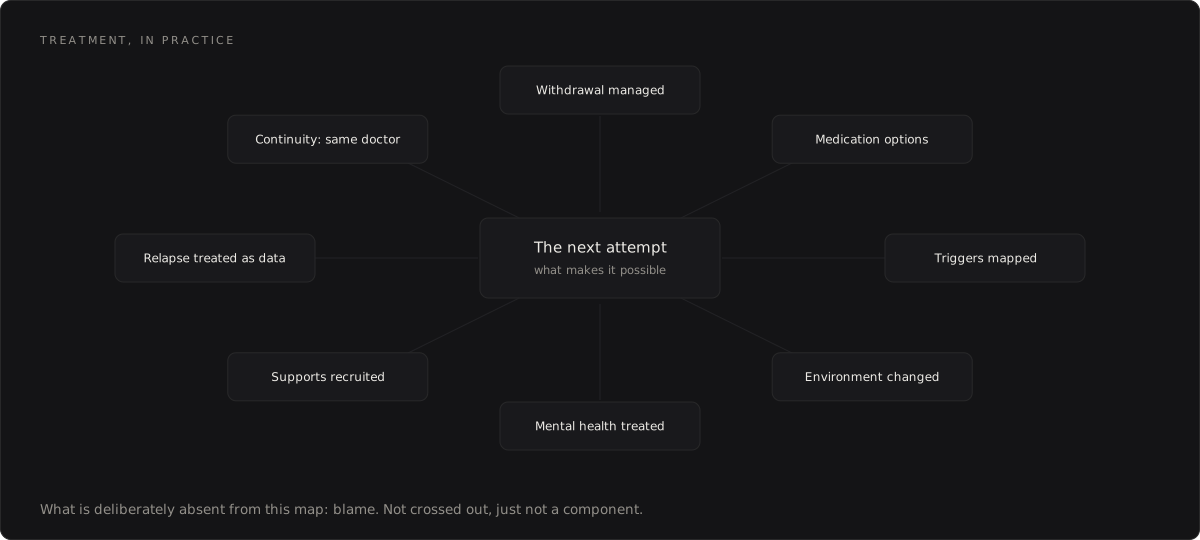
Changing the terms looks less dramatic than people expect. It means managing withdrawal properly, so the body is not casting a vote every few hours. It means using medication where good options exist, and they exist for several of the common dependencies, to quieten craving or take the reward out of the substance. It means mapping the actual triggers, which are specific and personal, and redesigning around them, because avoiding a cue costs far less willpower than resisting one. It often means treating what is underneath: depression, anxiety, ADHD, chronic pain and past trauma all show up alongside addiction far more often than chance, and a dependence frequently starts life as someone's best available treatment for something untreated. And it means a plan with a goal the person actually chose. For some people that goal is stopping entirely. For others it is cutting down, or using more safely while other things stabilise. Both are legitimate medicine, and progress toward either counts.
Relapse deserves its own honest paragraph, because it is where the morality tale does the most damage. Addiction behaves like the other chronic, relapsing conditions we manage every day, and a return to use is information, not a verdict: what was the trigger, what part of the plan failed, what needs adjusting. Nobody treats a blood pressure flare as proof the patient is beyond help. The same logic applies here, and it points in a genuinely hopeful direction, because the long-term evidence is clear that most people with addiction get better, many with treatment, some without, and the odds improve the earlier the conversation starts.
Which is the last thing worth saying, and the reason this article exists. You do not need to have lost anything yet to raise this with a GP. There is no entry requirement, no rock bottom to qualify for, and no lecture waiting on the other side of the sentence "I think I have a problem with this". It is a medical conversation like any other, held with the same confidentiality as any other, and it usually starts smaller than people fear: what, how much, how long, what has it cost you, what do you want to be different. The morality tale has exactly one function, which is to keep people out of the room. Leave it at the door. The medicine is inside.
Two practical notes before the door. Coming off some substances abruptly can be dangerous in itself. Alcohol and benzodiazepines are the main ones: a sudden stop can be medically serious, so the conversation should come before the stopping, not after. And none of this has to wait for business hours or a free appointment: in Victoria, DirectLine (1800 888 236) answers around the clock, Lifeline is 13 11 14, and an emergency is still 000.
Prefer the full experience? Read this essay in the house. Machine-readable: markdown source.