The pairing that shouldn't work
The Focal Utopia finally clicked, on an OTL tube amp that every impedance rule says it should hate. A field report from the wrong side of the spec sheet.
I walked into my local headphone store on a simple mission: find an amp that would finally do my Utopias justice. Hours later, I was still there, cycling through a lineup of TOTL amplifiers, and every single one left me cold. Not bad, mind you. Competent. Technically impressive. And completely unable to justify replacing anything I already owned.
That's when the doubt crept in. Maybe the problem wasn't the amps. Maybe I'd been overrating the Utopia this whole time. Because when I put it next to genuine S-tier experiences, the STAX X9000 or the HD800S running off a HeadAmp Blue Hawaii SE, the Utopia wasn't delivering that same "something special". Those setups have a quality that transcends spec sheets. The Utopia, for all its speed and precision, felt like it was still waiting for something.
Just as I was settling into that depressing conclusion, a half-remembered Head-Fi post surfaced from the back of my brain: Focal themselves apparently pair the Utopia with the Feliks Euforia Evo at demos.
On paper, this is stupid
Let's be honest about what this pairing looks like from an engineering standpoint. The Euforia Evo is an OTL tube amp. OTL designs live and die by load impedance, which is why they're the natural home of 300 ohm Sennheisers and high-impedance ZMFs. The Utopia is a low-impedance, ultra-sensitive dynamic with a beryllium driver that will happily expose every flaw upstream. High output impedance into a load like that should mean a mangled frequency response and flabby, undamped bass.
So no, this shouldn't work. Which is exactly why I had to try it.
Then it did
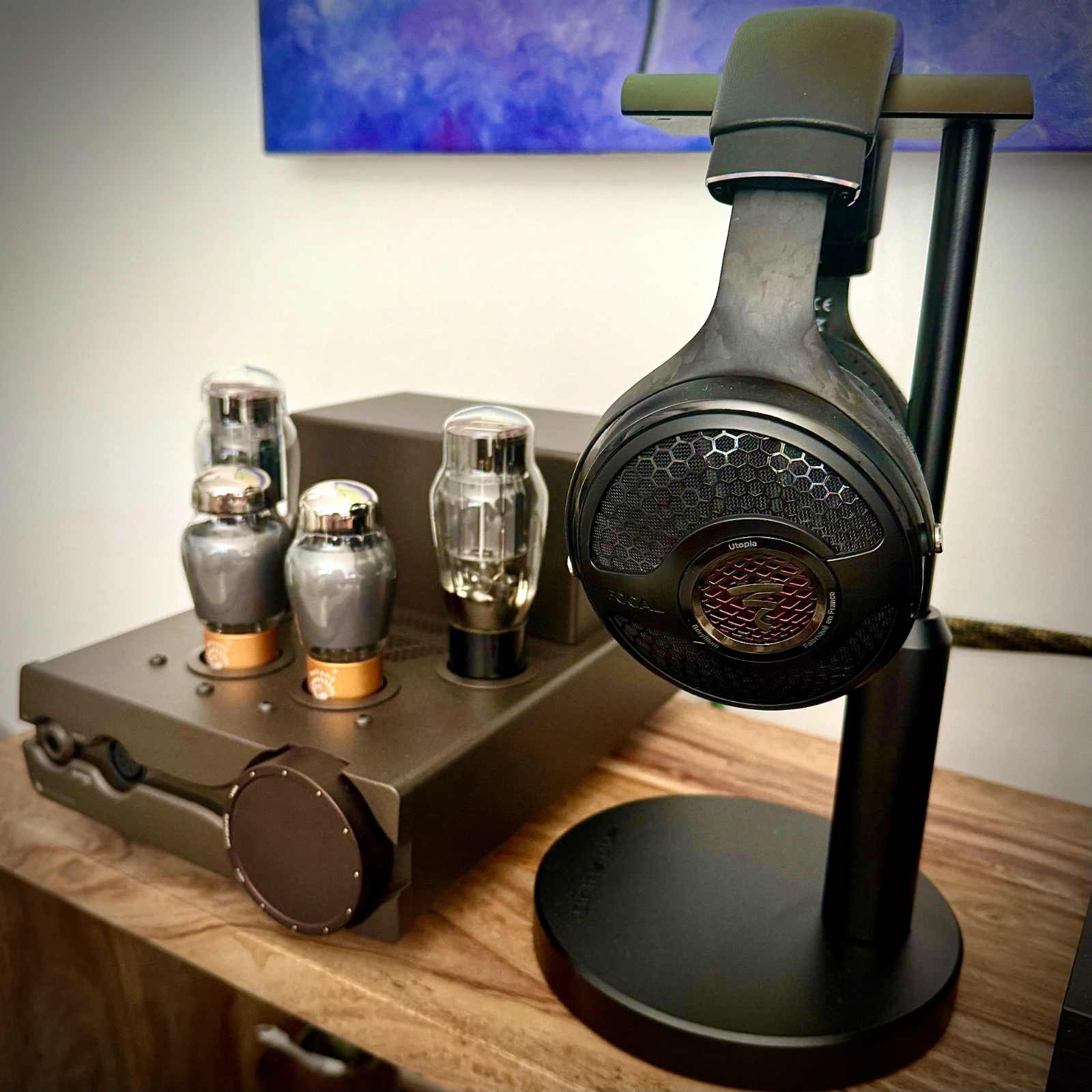
I loaded up my Qobuz testing playlist fully braced for disappointment, ready to confirm my priors and move on with my life.
Instead, every complaint I've ever had about the Utopia just... vanished. What the actual fuck.
Let me be precise about what changed, because this isn't a "tubes make everything warm and gooey" story.
Timbre. This is the headline. Vocals and guitars sounded lifelike in a way I have never heard from the Utopia, or honestly from much else. Not "impressively realistic for a headphone". Actually lifelike. The dry, slightly sterile character the Utopia can have was replaced with genuine body and texture.
Dynamics and impact. The Utopia has always been fast, but on the Euforia it hits with real weight behind the speed. Macrodynamic swings land properly. Transients have consequence instead of just precision.
Note weight. Everything gained density without gaining bloat. Notes have mass now.
And what didn't change, for balance: this is not the most resolving pairing you can build around a Utopia, and if raw detail retrieval is your religion, a top solid-state amp will edge it out. The soundstage improved slightly, nothing dramatic. Imaging was already essentially perfect on the Utopia and remains so.
But here's the thing. I'd trade a sliver of resolution for this presentation every single time. This combo produced the closest thing to virtual reality in audio I've experienced. Close your eyes and the performers are simply there.
The takeaway
Two things.
First, if you own a Utopia and get any opportunity to hear it on a Euforia Evo, do it, and then come tell me whether your experience matches mine. I'm genuinely curious whether this is unit synergy, my particular sonic priorities, or something Feliks and Focal quietly figured out that the rest of us are late to.
Second, and this is the bigger lesson: the spec sheet said no, conventional wisdom said no, and every impedance-matching rule of thumb said no. The pairing that finally unlocked the Utopia for me was the one I nearly didn't bother trying because it looked wrong on paper. Sometimes the best thing you can do in this hobby is ignore the theory for an afternoon and just listen.
Prefer the full experience? Read this essay in the house. Machine-readable: markdown source.