The Only Two Things I Know
Ontological mathematics, and the rabbit hole that accidentally led somewhere: from an Illuminati LARP on a conspiracy forum to Leibniz, Euler, and the oldest question there is.
A note before we start: this essay treats fringe internet cosmologies as objects of intellectual archaeology, not as endorsements. It is a story about where ideas come from, how they travel, and what, if anything, survives scrutiny.
Two certainties
Strip away everything I merely believe, and two things are left standing.
Something is being experienced right now. Not "I have a brain" or "I am a person in Australia", those are theories. The raw fact underneath them is that experience is occurring. Descartes got famous for noticing this, but you don't need him; you just need to pay attention for one second. You cannot doubt it, because the doubting would itself be an experience.
Two plus two is four. Not "usually", not "in our universe", not "pending further data". It could not have been otherwise. Mathematical truth doesn't ask permission from physics, and no experiment will ever overturn it.
That's the whole inventory. Everything else, atoms, brains, other minds, the past, this website, is inference. Good inference, hardworking inference, inference I'd bet my life on daily. But inference.
Now notice something strange about my two certainties. One of them is the most private thing imaginable: my experience, accessible to exactly one observer. The other is the most public thing imaginable: a truth that holds for every mind everywhere, forever, whether or not anyone checks. They shouldn't have anything to do with each other. And yet the entire history of physics is the story of the private thing (observation, experience) being described, with obscene precision, by the public thing (mathematics).
What if that's not a coincidence? What if the two certainties are two faces of one fact?
That question has a name, several actually, and one of them is ontological mathematics. This essay is about that idea: where I found it (somewhere deeply embarrassing), what it actually claims, which parts are ancient and respectable, which parts are modern and respectable, and which parts are absolute cooked nonsense. I won't validate it and I won't dismiss it, because I've learned the hard way that the universe doesn't reward either reflex.
But first, the confession.
The stupid door
Good ideas are supposed to arrive through good doors: a lecture, a journal, a wise mentor. Mine arrived through the dumbest door available, and I think there's an honest lesson in admitting that.
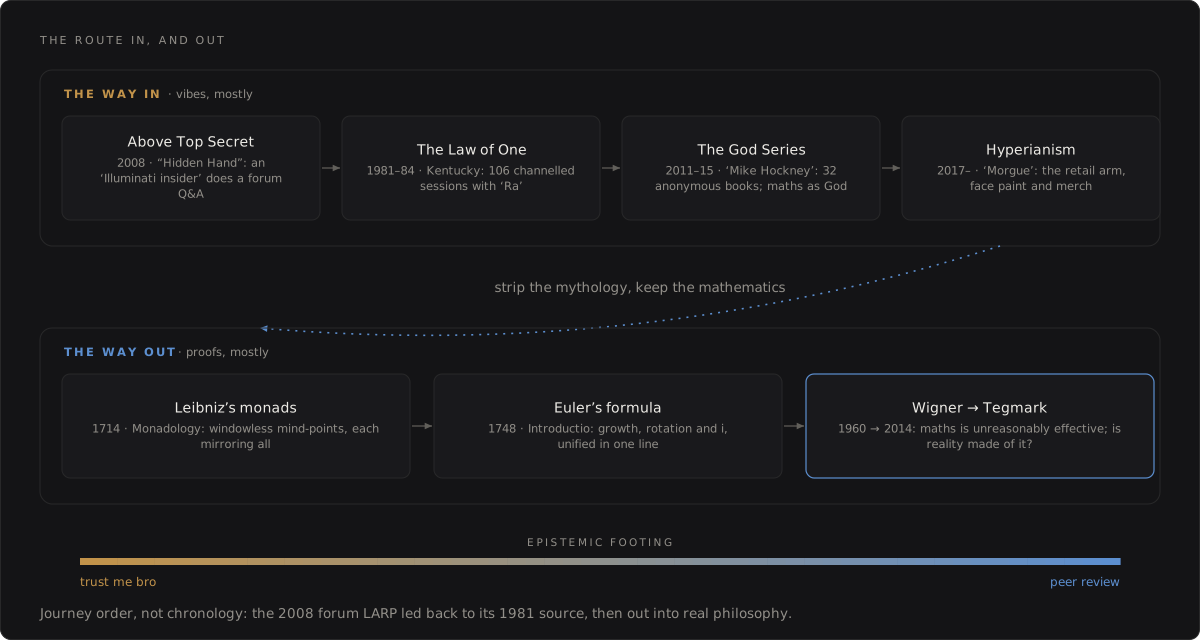
In my conspiracy-curious years I spent a lot of time on Above Top Secret, the great sprawling forum where every flavour of paranoia had its own subforum and its own regulars. And in October 2008, a user calling themselves Hidden Hand turned up claiming to be, and I quote, "a generational member of a Ruling Bloodline Family", here to answer questions because a rare "window of opportunity" required his people to reveal themselves to their subjects. What followed was days of Q&A: a complete cosmology of ruling bloodlines above the bloodlines you've heard of, a Creator's Law, a Law of Free Will that meant he could only answer what was directly asked, souls choosing "polarity", and a coming Harvest in which humanity would be sorted by its spiritual orientation.
Crazy shit. Genuinely. And I mean that as a description, not entirely as an insult, because whoever wrote it was committed. The prose had this eerie, patient, in-character calm. The internal logic held together. It was, hands down, the best-written piece of villain roleplay the internet has ever produced.
It was also checkable, which is the part people forget. Hidden Hand made concrete predictions: a new currency and a new union of nations by early 2009, San Francisco and Damascus uninhabitable by the end of 2010, a solar emission around 2009 or 2010 melting the ice caps. Every single falsifiable claim failed. All of them. That's the quiet beauty of predictions: they're the only part of a cosmology that can be marked, and this one scored zero.
But here's what made the thread genuinely educational rather than just entertaining. Years later I read the Law of One, also called the Ra Material: 106 channelling sessions recorded between 1981 and 1984 in Louisville, Kentucky, by a physics professor turned airline pilot named Don Elkins, a librarian and trance channel named Carla Rueckert, and a scribe named Jim McCarty. Through Rueckert, an entity calling itself Ra, describing itself as a "sixth-density social memory complex" that evolved on Venus, delivered an entire metaphysics: densities of consciousness, a harvest, the polarity of service-to-others versus service-to-self, the supremacy of free will. The prose has that same flat, patient, faintly alien calm. (The story ends darkly: Elkins died in 1984, and the sessions ended with him. His death was a suicide, at the end of a long deterioration the people around him later wrote about with great sadness. I note it plainly rather than as a punchline, because it deserves better than one, and because it belongs to the honest record of what this material cost the people closest to it.)
Read the two documents side by side and it hits you like a truck: Hidden Hand is Law of One fan fiction written from the antagonist's point of view. Same harvest, same polarities, same free-will legalism, same densities, just narrated by the baddie. Even the sceptics' encyclopaedias note how heavily the 2008 thread borrows from the 1981 material. Once you see it, you cannot unsee it.
And that was my first real lesson in source criticism, learned in the least reputable classroom on Earth: cosmologies have genealogies. Nobody's secret knowledge comes from nowhere. Every revelation has a bibliography, whether or not the revelator admits it. Ask "where did this idea come from?" and the mystique starts dissolving into ordinary human authorship, with all the borrowing, remixing and unpaid citations that implies.
Hold onto that lesson. We're about to need it.
Books with nobody's name on them
Somewhere in that same era of algorithmic spelunking, I ran into the God Series: thirty-two books, roughly a million words, published between 2011 and 2015 under the pseudonym Mike Hockney (say it out loud; yes, they knew), claiming to be written by senior members of "the most ancient secret society in the world", the Pythagorean Illuminati. The associated website, Armageddon Conspiracy, had been humming away in the same corners of the internet for years. Nobody knows who they are. The books are self-published, furious, wildly repetitive, and deliberately structured, by their own admission, to keep the reader off balance by lurching between high mathematics, German idealism, quantum mechanics and episodes of The Simpsons.
The tone is something else. These are books that tell you, in the actual marketing blurb, not to read them if you're a stupid, cheap and petty person. There's a whole chapter sorting humanity by Myers-Briggs type, with intuitives anointed as the cognitive elite and "sensing types" dismissed as constitutionally incapable of truth. It is contempt as a literary genre. My bullshit detector, which I'd like to think is reasonably well calibrated after years of general practice and internet archaeology, was going off constantly.
And yet. Underneath the sneering and the Illuminati cosplay, the actual claims were more interesting than anything Hidden Hand ever said, because they weren't about bloodlines or harvests. They were about mathematics. Here is ontological mathematics, stripped of the theatrics and stated as plainly as I can:
1 · Mathematics is not a description of reality. Mathematics is reality. Numbers aren't abstractions; they exist. Specifically, they are the frequencies of sinusoidal energy waves. Existence, at bottom, is made of sines and cosines.
2 · The universe obeys one supreme law: the Principle of Sufficient Reason. Everything must have a reason why it is so and not otherwise. Brute facts are forbidden. Only mathematics, the system where nothing is arbitrary, can satisfy this.
3 · Minds are monads: dimensionless mathematical points, borrowed directly from Leibniz (whom the books cheerfully claim as a former Grand Master). Each monad is an eternal, unextended frequency domain. Zero, the number of the soul; a nothing that contains infinity.
4 · Euler's Formula is the fabric of existence, the "God Equation" from which everything is woven.
5 · Mind and matter are linked by Fourier mathematics. The unextended frequency domain (mind) and the extended spacetime domain (matter) are two representations of the same information, translated back and forth by the Fourier transform. This, they claim, dissolves Cartesian dualism in one move.
6 · Real numbers correspond to space, imaginary numbers to time; science's mistake was building on real numbers alone and pretending zero, infinity and i aren't ontologically serious.
Whatever else you want to say about this list, it is not the usual conspiracy slop. There are no lizards. There's no adrenochrome. It's a rationalist metaphysics with a body count of exactly zero and a reading list that includes Pythagoras, Plato, Leibniz, Euler, Hegel and Gödel. The packaging is a cult. The payload is a philosophy syllabus.
Remember the lesson from the stupid door: cosmologies have genealogies. So I did the only sensible thing. I ignored the anonymous authors' claims about themselves entirely, and went and read their sources.
The retail arm
Before we get to the sources, one more stop on the tour of the weird, because you cannot talk about ontological mathematics on the internet in the 2020s without tripping over Hyperianism.
Around 2017, a former sideshow shock performer who goes by Morgue, a man whose prior career highlights involve swords and the insides of his own face, began preaching ontological mathematics on YouTube under a new brand. Black clothing, white face paint, a geometric logo called the Hyperian Star, a founding text called the Unity Document, an origin story about contact with "secret societies", and a slogan straight off a t-shirt: "You are a Mind. Existence is Thought. The World is a Dream." He wrote his own primer, Ontological Mathematics: The Science of the Future, in 2019. Membership community, courses, merch. The full funnel.
The content is, to put it charitably, a streamlined retelling of the God Series: reality as a shared dream, matter as illusion, spacetime as a Fourier projection from a frequency singularity called the Source. To put it less charitably, the Pythagorean Illuminati's own online community publicly disowned him, with former members and rival authors accusing him of plagiarising the whole apparatus and running a personality cult. Sit with that for a second: the anonymous secret society that claims to be thousands of years old issued what amounts to a cease-and-desist against the guy in face paint for stealing their homework. I have watched a lot of internet drama in my life and this remains a personal favourite.
I bring Hyperianism up not to dunk on it (well, not only to dunk on it) but because it demonstrates something important about ideas: an idea's worst salesmen are not evidence about the idea. Morgue's aesthetic is a red flag for Morgue. The God Series' contempt is a red flag for its authors. Neither tells you whether mind and mathematics are actually related, any more than a televangelist tells you whether God exists. If you want to evaluate the claim itself, you have to walk past the merch table.
So let's walk past it.
The respectable ancestors
Here's the thing the anonymous authors were right about, and it's a big thing: the idea that reality is fundamentally mathematical is not fringe. It might be the oldest continuous idea in Western philosophy.
Start about 2,500 years back. Pythagoras and his school held that all is number: that number wasn't a tool for measuring reality but the very stuff of it. They found that musical harmony, the most emotional thing humans do, reduces to whole-number ratios of string lengths, and they took that as a revelation about everything. The school reportedly ran on secrecy and hierarchy; legend even has them drowning poor Hippasus for proving that the square root of two can't be written as a ratio, a story that is almost certainly apocryphal but too good not to mention. The point stands: mathematics-as-religion is not a 2011 self-publishing phenomenon. It's the founding startup of Western thought, and Plato was its most successful fork, with his realm of perfect Forms of which the physical world is a shadow.
Then the figure the whole edifice actually rests on: Gottfried Wilhelm Leibniz. Co-inventor of calculus, inventor of binary arithmetic, dreamer of a characteristica universalis, a universal logical language in which all disputes could be settled by calculation. ("Let us calculate," he imagined disputants saying, three centuries before we built machines that do little else.) In 1714 he wrote the Monadology, ninety dense paragraphs proposing that reality consists of monads: simple, partless, unextended substances. Because they have no parts, they can't be assembled or broken; because they're unextended, they aren't material. Each monad is fundamentally mind-like, characterised by perception and appetite, and each one mirrors the entire universe from its own point of view. They are "windowless", nothing goes in or out, yet they all agree with one another because of a pre-established harmony. And ruling over the whole system, Leibniz's supreme law: the Principle of Sufficient Reason, nothing is so without a reason why it is so.
Sound familiar? It should. Ontological mathematics is essentially Leibniz radicalised: take the Monadology, swap "God's pre-established harmony" for "Fourier mathematics", declare the monads to be frequency domains, and publish it with worse manners. The anonymous authors' single most honest act was crediting him.
And a word for Hegel, who the God Series also drafts into its hall of fame. Hegel's absolute idealism held that reality is rational through and through, that the rational is the real, and that the universe is Mind (Geist) progressively coming to know itself through history, driven by the dialectic. (Pedant's footnote: the "thesis, antithesis, synthesis" formula everyone attributes to him is really Fichte's schema, popularised later. Hegel's actual method is messier and better.) You can see why the maths-mystics love him: a universe that is thought thinking itself is precisely the vibe they're selling. Hegel just never mailed the merch.
So the genealogy is real. The lineage from Pythagoras through Plato to Leibniz and Hegel is exactly the lineage a "mathematics is mind is reality" doctrine should claim, and unlike the bloodline stuff on Above Top Secret, this bibliography checks out. The anonymous authors didn't invent their philosophy. They inherited it, sharpened it, and wrapped it in a persona. Cosmologies have genealogies; this one's genealogy is legitimate royalty.
Which brings us to the crown jewel. Literally, as it turns out.
The jewel
In 1748, Leonhard Euler, the most prolific mathematician who has ever lived, published the relationship that sits at the centre of this whole story:
e^(iθ) = cos θ + i sin θ
Set θ to π, the half-turn, and it collapses into the most famous single line in mathematics:
e^(iπ) + 1 = 0
Richard Feynman, teaching it to undergraduates, called it our jewel and the most remarkable formula in mathematics. Benjamin Peirce, the great Harvard mathematician, reportedly told a class that it was absolutely paradoxical: they couldn't understand it, and didn't know what it meant, but they had proved it, and therefore it must be the truth.
Look at what's in it. e, the base of natural growth, extracted from compound interest and radioactive decay. i, the "imaginary" unit, invented under protest to solve cubic equations. π, the circle's own number, known to the ancients. 1, the unit, identity itself. 0, nothing, the void that took humanity millennia to accept as a number. Five constants from five utterly separate provinces of mathematics, developed across thousands of years for unrelated reasons, and they lock together in one line with nothing left over.
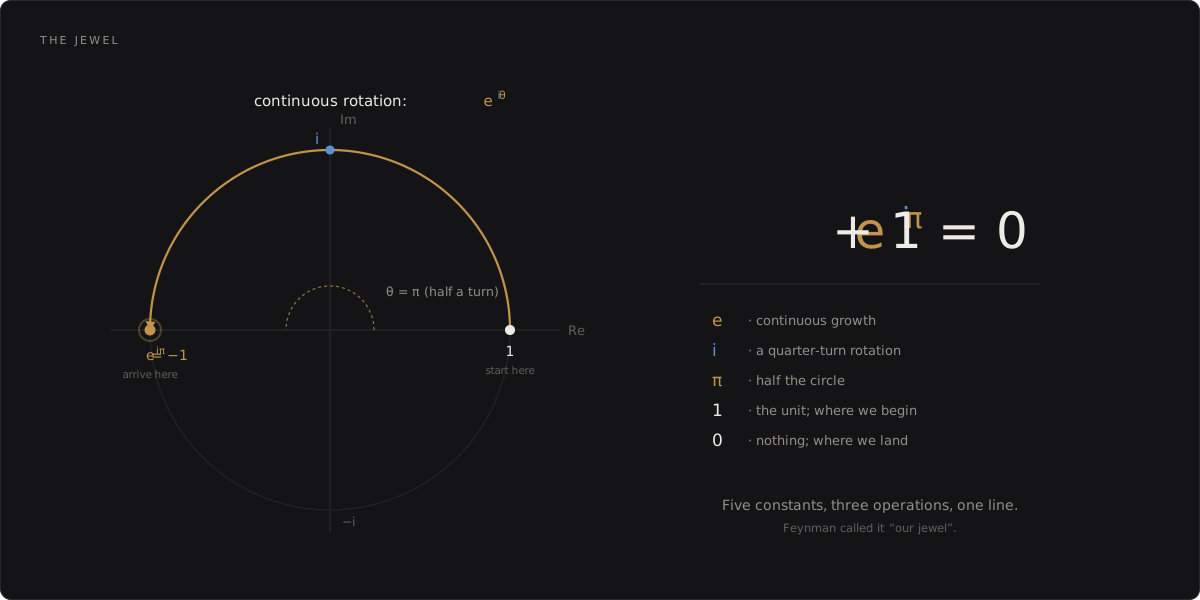
Now, the sober reading, because you deserve both readings. Once you understand complex numbers, the identity is not spooky, it's inevitable. Multiplying by i is a quarter-turn rotation in the plane. The exponential e^(iθ) is what continuous rotation looks like when you write it as growth. Run the rotation for half a turn, θ = π, and of course 1 arrives at −1. The formula is a compressed statement that growth and rotation are the same operation viewed through different windows, and every electrical engineer uses that fact before morning tea without lighting incense.
But the sober reading, honestly held, doesn't kill the wonder; it relocates it. The genuine mystery was never "how weird that these symbols line up". The mystery is that rotation, a thing bodies do in space, and growth, a thing quantities do in time, and waves, the thing everything in physics turns out to be made of, are all one structure, and that this structure was sitting inside arithmetic waiting to be found, and that the universe, when we finally looked closely at light and electrons and probability amplitudes, turned out to run on exactly this piece of machinery. Complex exponentials aren't a notation we imposed on quantum mechanics. They're what quantum mechanics is written in. Schrödinger's equation has an i in it, structural, non-negotiable.
The God Series calls Euler's Formula the God Equation, which is marketing. But when Hockney says energy waves are just sines and cosines and existence is built from them, he is standing embarrassingly close to something every physicist already believes on weekdays. The crackpots didn't discover the jewel. They just stared at it longer than polite society considers healthy, and I have some sympathy for that, because I've done my share of staring too.
The bridge nobody talks about
If Euler's identity is the jewel, the Fourier transform is the wall it hangs on, and it's the one place where the God Series stops shouting long enough to say something structurally interesting.
Joseph Fourier, studying heat flow in the 1820s, showed that essentially any signal can be decomposed into a sum of pure sinusoids. That gives every waveform two complete descriptions. There's the spacetime domain: the wiggling line, the thing unfolding moment by moment. And there's the frequency domain: the recipe, the list of which pure tones at which strengths compose it. The transform converts between them, losslessly, in both directions. Neither description is "more real". They are the same information wearing two outfits.
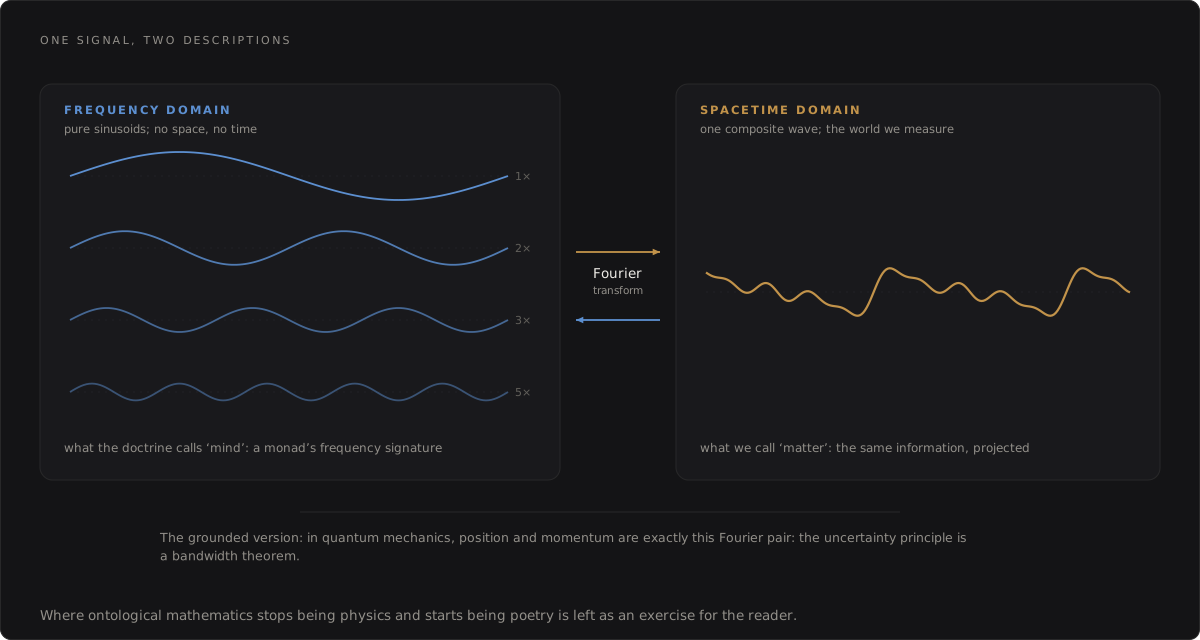
Now watch what ontological mathematics does with this. A monad, it says, is a complete frequency domain: dimensionless, outside space and time, exactly as a frequency spectrum has no location or duration. Your mind is the recipe. The physical world is the collective inverse transform, the projection of all the recipes into a shared spacetime performance. Mind and matter stop being two substances that mysteriously interact, Descartes' famous headache, and become two representations of one mathematical object. Dualism doesn't get solved; it gets dissolved, the way "is the wiggle real or is the recipe real?" dissolves once you understand the transform.
I want to be straight with you about my reaction to this, because it was not simple. As a metaphysical picture it is elegant as hell. And it's not floating free of real physics either. In quantum mechanics, position and momentum are exactly a Fourier-conjugate pair; the Heisenberg uncertainty principle is, at bottom, a bandwidth theorem, the same trade-off that says a drum hit sharp in time is smeared in pitch. David Bohm spent his late career on an "implicate order" enfolded beneath spacetime; Karl Pribram spent his on a holonomic theory of the brain. Neither panned out into mainstream science, but neither man was a face-painted YouTuber. The frequency-domain intuition keeps recurring among serious people because the mathematics genuinely does licence a picture in which spacetime is not the deepest layer of description.
Here's what the mathematics does not licence, and this is the leap you should watch the mystics make in slow motion: it does not licence promoting a representation into a residence. The frequency domain is a description of a signal, not a postcode where souls live. Fourier gives you the bridge. He does not give you the traffic, and he definitely does not give you the toll-collecting secret society at one end of it. When ontological mathematics says the frequency domain is literally an eternal mental realm, it has stopped doing mathematics and started doing poetry with mathematical vocabulary. Sometimes poetry is where truth lives. But you're owed the disclosure of exactly where the genre changed.
The respectable descendants
So much for the ancestors. What makes this whole subject impossible to simply bin is that the descendants are respectable too. The question "is reality mathematical?" is not settling into the pseudoscience sediment. It's getting louder at the serious end.
In 1960, physicist Eugene Wigner published a paper whose title has become a permanent fixture of the conversation: on the unreasonable effectiveness of mathematics in the natural sciences. His observation: concepts invented by mathematicians for pure aesthetic reasons, complex numbers being the standout example, keep turning out, decades or centuries later, to be precisely the language physics needed. He called it a miracle we neither understand nor deserve, and he wasn't being cute. Richard Hamming extended the puzzle in 1980 and couldn't crack it either. The honest counterargument exists and deserves its airtime: maybe it's a selection effect. We frame the domains where maths triumphs and quietly avert our eyes from where it flails: consciousness, most of biology, the entirety of my Thursday clinic list. No equation has ever walked into a consulting room and sorted out a human being. Maybe mathematics is a hammer, and we've been curating a museum of nails.
Maybe. But the physics keeps not cooperating with the deflationary story. John Archibald Wheeler, one of the great physicists of the twentieth century, spent his final decades on it from bit: the proposal that every physical thing derives its existence from information, from binary answers to yes/no questions, that physics at bottom is informational rather than material. And then Max Tegmark, cosmologist at MIT, took the whole thing to its terminus with the Mathematical Universe Hypothesis: the universe doesn't just obey mathematics, it is a mathematical structure, and moreover every consistent mathematical structure exists physically, a "Level IV multiverse" of all possible maths. His argument is cleaner than it sounds: if reality exists independently of humans, its complete description must be free of human baggage, and a description with all the baggage stripped out just is a mathematical structure. He put it in a 2007 paper and a 2014 book, Our Mathematical Universe, from a chair at one of the most credentialed institutions on Earth.
Tegmark's MUH is ontological mathematics with the mind deleted and the manners installed. Which is exactly why the reception is instructive. Physicist Peter Woit's review landed the cleanest hit, saying the trouble is "not that it's wrong but that it's empty". Mathematician Edward Frenkel, in the New York Times, accused the book's speculative half of leaving science for mysticism while keeping the costume on. Cosmologist George Ellis pointed out that causally disconnected universes are, by construction, beyond any scientific support. And the deepest cut came from logic itself: in a debate with Piet Hut and Mark Alford, Tegmark was pressed on Gödel, whose incompleteness theorems guarantee that any formal system rich enough for arithmetic contains truths it cannot prove and cannot certify its own consistency. How can reality be a formal structure if formal structures are constitutionally leaky? Tegmark's response was to retreat to a "Computable Universe Hypothesis" admitting only Gödel-safe structures, while openly conceding this excludes most of mathematics and that virtually every successful physical theory violates it. I respect the concession more than the hypothesis. At least he showed his working, which is more than the Pythagorean Illuminati ever did; their answer to Gödel is essentially that ontological mathematics isn't that kind of system, which is convenient in the way that answers you grade yourself always are.
Meanwhile, in academic philosophy proper, the underlying question has never gone away, and here is where it gets genuinely sharp. Gödel himself was a mathematical platonist: he believed mathematical objects exist and that we perceive them with something like a special faculty. The Quine-Putnam indispensability argument says we're rationally committed to the existence of mathematical objects because our best physics cannot be stated without them. And against all this stands Benacerraf's dilemma, published by Paul Benacerraf in 1973 and still undefeated: if mathematical objects are real but abstract, they are causally inert, so how does a physical brain in Melbourne come to know anything about them? But if mathematics is just mental convention, why is it necessary, why does it bind every possible mind, and why does the universe obey it? Pick your poison: real objects we can't touch, or human inventions with the authority of gods. Nobody has cleanly escaped in fifty years.
Except, notice, there is one door out of Benacerraf's trap, and it's the door this whole essay has been circling. If mind is itself a mathematical structure, the access problem evaporates. You don't need a causal pipeline to a Platonic realm; knowing mathematics would be self-acquaintance, structure recognising its own kind. That is precisely the wager ontological mathematics makes, and, stripped of the Illuminati drag, it's the same wager Parmenides made at the very dawn of philosophy: the same thing is for thinking and for being. The coin thesis. Twenty-five centuries old, and still the only tidy answer on the table, which is either a profound clue or a warning about tidy answers.
The other half of the coin has its modern champions too. Bernardo Kastrup's analytic idealism argues consciousness is the fundamental substrate and the physical world its appearance; and Giulio Tononi's Integrated Information Theory attacks from the opposite flank, trying to measure consciousness with mathematics, assigning it a quantity, phi. IIT got itself denounced as pseudoscience in a 2023 open letter signed by over a hundred researchers, and defended just as loudly, which tells you the fight over mathematising mind is not history. It's this week.
The audit
Right. Bullshit detector back out. Here is the honest damage report on ontological mathematics as a doctrine, because being fascinated by a question doesn't oblige me to be gentle with a bad answer.
It is unfalsifiable by design. Say this for Hidden Hand: the coward's cosmology at least had the courage to predict things, and we got to watch every prediction die. Ontological mathematics predicts nothing checkable. It explains everything, forbids nothing, and therefore, by the only standard that has ever reliably separated knowledge from vibes, it isn't knowledge. Woit's verdict on Tegmark applies here with double force: not wrong, empty.
Its supreme law is smuggled in, not proven. The Principle of Sufficient Reason is presented as self-evident, but "reality must satisfy my demand for reasons" is itself a brute preference. A universe with brute facts is perfectly conceivable; declaring it forbidden is theology with the serial numbers filed off.
Gödel is not answered by asserting he doesn't apply. A self-grounding, complete, self-consistent mathematical reality is exactly the kind of thing incompleteness makes suspicious. Waving it away because your maths is "analytic sinusoids rather than axioms" is a distinction that would need, at minimum, an actual proof. None is offered. Tegmark bled publicly over this problem; Hockney declared victory in a font.
"Why Euler's Formula?" has no answer. Elevating one theorem to the fabric of existence repeats numerology's founding move. Euler's Formula is a consequence within analysis, not a foundation beneath it. And why should sinusoids be the privileged basis? Signal processing decomposes the same reality into wavelets when it suits; nobody starts a religion about them. The choice reveals the author, not the universe.
The hard problem does not dissolve by rebranding. Call the mind a frequency domain and you've relabelled the mystery, not solved it. Why should a Fourier spectrum feel like something from the inside? The explanatory gap between structure and experience is exactly as wide as before; it's just wearing new notation. That gap is the actual problem, and no one, not Hockney, not Tegmark, not Tononi, not me, has closed it.
And the sociology is a five-alarm fire. Anonymous authorship immune to accountability. Systematic contempt for outsiders. Flattery of the reader as one of the rare intuitive elect. A retail arm with subscriptions and schisms and excommunications. This is the guru pattern, fully expressed, and it exists for a reason: rationalism that refuses empirical check has no external correction mechanism, and a belief system with no correction mechanism is a personality with footnotes. Astrology with better typography.
That's the demolition. Here's what's still standing in the rubble, and I want to be just as clear about this: the questions survive intact. Why is mathematics unreasonably effective? Is it discovered or invented? How do physical brains access necessary truths? Is consciousness fundamental, emergent, or structural? Every one of those is a live, open, respectable question that the smartest people alive disagree about. The cranks didn't invent the questions. They just answered them prematurely, with total confidence, which is the one move the universe never forgives.
The coin, still spinning
I'll end where I started, with a card face-up on the table about why I care.
My working life sits at the junction of medicine and machine intelligence. Half my week I'm around human minds, watching what they do under load, how they break, how they heal, how stubbornly they refuse to reduce to any tidy model I was taught. The other half I'm around artificial ones, systems built from nothing but mathematics, matrix multiplications all the way down, that nonetheless converse, reason, and surprise me daily. When you spend your days watching mathematics do things that look suspiciously like thinking, the question "are mind and maths the same thing seen from two sides?" stops being a stoned dorm-room hypothetical and starts being a description of your Tuesday.
So here is where I actually land, stated as carefully as I can.
I don't believe ontological mathematics. Belief is the wrong verb for an unfalsifiable doctrine sold by anonymous authors with contempt issues, and I've watched too many confident cosmologies fail their own predictions to hand my credence to another one. But I don't dismiss the intuition underneath it, because that intuition has the oldest pedigree in philosophy, the endorsement-by-adjacency of working physics, and, in the Benacerraf escape, the only clean answer anyone has offered to a fifty-year-old dilemma. The weird got me into the interesting, and the interesting turned out to hold real weight.
What the whole journey actually taught me is a method, and the method is worth more than any conclusion:
Cosmologies have genealogies. Trace every revelation to its bibliography. The mystique rarely survives the citation check.
Judge ideas naked. Strip the persona, the merch, the contempt, the face paint, and weigh what's left. An idea's worst salesmen are not evidence about the idea.
Predictions are the only marks on the exam. Hidden Hand failed his. Doctrines that refuse to sit the exam don't get graded higher; they don't get graded at all.
Don't validate. Don't dismiss. Update. The universe has been consistently weirder than the sceptics allowed and consistently more lawful than the mystics hoped, and both camps hate this.
The questions never get answered. I made my peace with that a long time ago. They just get more specific, more technical, better dressed, and they hand you off from a conspiracy forum to a channelled book to an anonymous cult to a dead German genius to the most beautiful equation ever written to a live fistfight in the philosophy of mind, and somewhere along that handoff you realise the getting-less-wrong was the destination.
Two certainties. One private, one universal. One that feels, one that proves. Twenty-five centuries of the best minds we've produced, and nobody has managed to weld them together or prise them cleanly apart.
The coin is still on its edge. I intend to keep watching it spin.
If you've made it this far and want the primary sources: Leibniz's Monadology (1714) is ninety paragraphs and freely available; Wigner's 1960 paper is a short, gorgeous read; Tegmark's Our Mathematical Universe (2014) is the respectable maximalist case; Benacerraf's "Mathematical Truth" (1973) is the knife. The God Series is thirty-two books of a committee shouting; read one, for texture, and only one. And the Hidden Hand thread is still archived around the internet, preserved exactly as it was in October 2008, predictions and all. Go see how the exam was marked.
Prefer the full experience? Read this essay in the house. Machine-readable: markdown source.