Explosion in Bits, Grind in Atoms
On the walls between here and superintelligence, and why the ones still standing are made of matter.
On the first pages of a recent Google DeepMind paper about the future of artificial intelligence sits a section addressed not to human readers but to machines. Summary instructions, in plain sight and openly labelled: if an AI is asked to summarise this document, here is how to structure it, what to emphasise, and, to the authors' credit, a request to include the report's shortcomings and caveats. The paper runs to fifty-odd pages on whether machines might one day exceed the minds that built them, and it opens by speaking directly to the machines that will read it.
The machine ignored the script. The review it produced was long and occasionally rude, and the argument that followed, between the model and the human who had asked for the review, ran on for days and ended somewhere neither party started. What follows is what survived that argument: a field report from the only debate that counts this decade, conducted in the only format that suits it, two different kinds of mind checking each other's work.
Six walls, pre-demolished
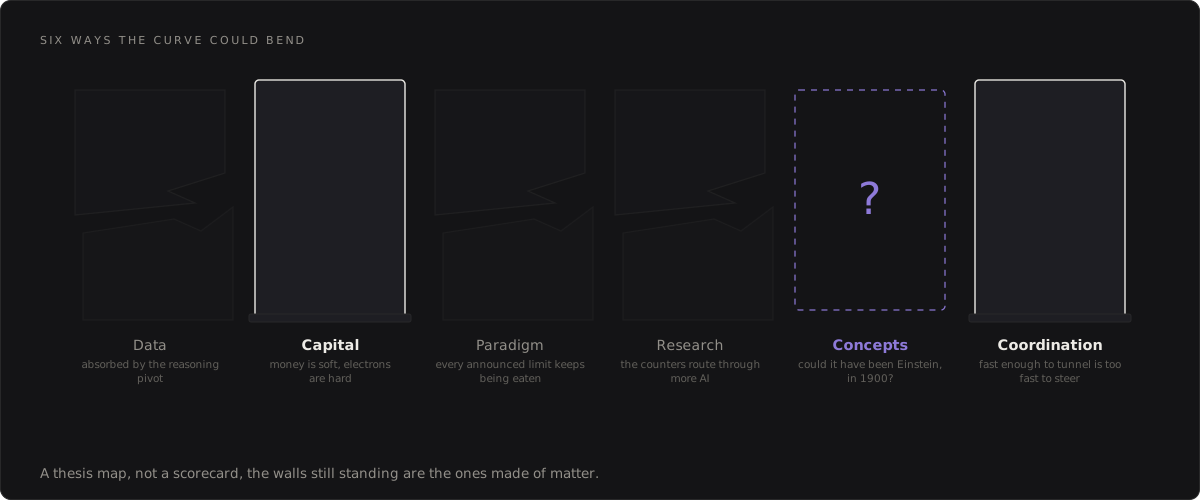
The paper's contribution is a list. Six ways the curve could bend before it goes vertical: the training data runs out; the money or the megawatts run out; the neural paradigm hits a ceiling; research gets harder faster than researchers get better; models prove unable to form genuinely new concepts; or humanity looks at the whole thing and chooses, collectively, to slow down.
It is a good list, and it arrives with a tell. Every wall comes pre-fitted with a column titled "countered by", and nearly every counter routes through the same door: more AI, more compute, better AI. No friction is ever permitted to hold real weight, because there is always an escape hatch, and the universal escape hatch, that collectives of models will scale past whatever an individual model cannot, is the one pathway the authors themselves admit is the least understood, with no historical base to forecast from. The optimism rests on the shakiest plank in the argument. Worth remembering as the walls come down.
And most of them do come down, quickly, because three of the six barely survived contact with the last eighteen months. The data wall, the fear that we exhaust high-quality human text, was quietly absorbed the moment the field pivoted from imitation to reasoning: capability decoupled from pretraining tokens, the binding input became reward signal and verification rather than prose, and the model-collapse spectre was defused by the mundane fix of accumulating real data alongside synthetic rather than replacing it. The claim that the neural paradigm itself is insufficient keeps being made and keeps being eaten; every announced limit, from planning to tool use to extended reasoning, has so far become the next component bolted onto the same substrate. And the deliberate slowdown dies to game theory: international anarchy acts as a filter selecting for whoever adopts the power-enhancing technology, one defector breaks any cartel, and sure enough the governance wave of 2023 reversed into a national-security arms race within two years, right on schedule.
What is left standing are the walls made of physics. Electrons, atoms, and one strange question about the nature of concepts.
Money is soft, electrons are hard
The numbers around AI infrastructure have stopped resembling an industry and started resembling a mobilisation. Roughly four hundred billion dollars of capital expenditure in 2025, north of seven hundred billion pencilled for 2026, a trillion floated for the year after, against a revenue base that one venture analysis famously calculated as six hundred billion dollars short of justifying the spend. Most enterprise pilots still show no measurable profit impact. Hyperscaler free cash flow has gone negative for the first time in a generation. Every ingredient of a classic bubble is present and accounted for.
But the capital question is a distraction from the physical one underneath it. A third to half of the data-centre capacity planned for 2026 is slipping toward 2028, not for lack of money but for lack of grid connections; transformers and turbines carry waiting lists measured in years; Microsoft is restarting a mothballed reactor at Three Mile Island and Meta is announcing nuclear strategies in gigawatts. The nuclear scramble is the tell. Capital moves at the speed of a term sheet. A gigawatt moves at the speed of poured concrete.
Read one way, this is the wall: the intelligence explosion, throttled at the substation. Read properly, it is a pressure, and pressure is the only thing that has ever made this industry efficient. DeepSeek exists because export controls made compute scarce for one set of labs, and scarcity did what abundance never does: it made someone clever. The same algorithmic gains had been sitting on the table for years; the cash-rich labs simply weren't hungry enough to pick them up. Jevons applies, of course, so efficiency will not relieve the draw, it will intensify it, letting the industry hit the same ceiling at a higher capability level. And a correction is likely, possibly a brutal one, vaporising capital and reshuffling who builds the thing toward whoever holds the cheapest power on Earth.
Here, though, is the sentence that breaks every historical comparison the bears reach for. Rail does not improve rail. Fibre never laid fibre. The overbuilds of 1873 and 2001 were gluts of inert capital: the track and the glass sat there, dumb, waiting decades for demand to grow into them. This asset works on itself. The output compounds into the input. Nothing in economic history has had that property, which is why every analogy, bullish or bearish, quietly fails at the same joint. For civilisation, the energy constraint is a pressure that forces evolution. For anyone whose plans live inside a three-year window, the lag between pressure and adaptation is real, and inside the lag, a pressure is indistinguishable from a wall.
The line
The deepest claim in the paper is about concepts. Models trained on the products of human cognition, it argues, are bounded by human conceptual primitives: they can recombine and explore within the spaces we defined, but cannot instantiate a genuinely new one, because forming a concept from raw reality supposedly requires an experiencing agent. The thought experiment is elegant. Train a frontier model on everything written before Newton and it will not hand you general relativity, because calculus, force and spacetime are not in its vocabulary and it has no way to mint them. Demis Hassabis likes to pose the same test as a question: could it have been Einstein, in 1900?
It is a serious claim, and its strong form has already been falsified, by systems most people file under "AI" without noticing they belong to a different lineage. AlphaZero was given nothing but the rules of Go and a reward, no human games at all, and discovered concepts no human possessed. We know this with certainty because the humans then learned those concepts from it, reversing twenty-five centuries of teacher and student in a single publication cycle. AlphaFold's internal representation of protein folding is not a remix of human structural intuition. AlphaEvolve recently found a way to multiply four-by-four complex matrices in forty-eight scalar multiplications, one fewer than Strassen's forty-nine, breaking a bound that had stood for over half a century, and it did so as part of a system that has already improved the training pipeline of the models that will succeed it. The abstraction barrier, stated honestly, is a claim about imitation: a system trained purely to mimic human text may indeed be trapped inside human primitives. The moment a system is grounded in something that can tell it when it is wrong, a verifier, a simulator, a reward, an opponent, concept formation from nothing is a demonstrated fact.
So the real question was never whether machines can think new thoughts. It is where the verifiers are. And the standard objection, that reality cannot be simulated, rests on a mistake about what simulation requires. No simulation goes all the way down, and none ever has. You do not need quantum field theory to simulate a cannonball. You do not simulate marbles to model galaxies, or proteins to model a heart, or neurotransmitters to model a mind. Every successful science is an existence proof that the universe is compressible at some level of description: that there is a coarse-graining at which a domain closes over itself and the details beneath it stop mattering. Simulation only has to be as deep as the question.
And this, awkwardly for the sceptics, is precisely how humans do it. No child learns that objects fall by deriving anything. You watch a ball drop a million times and your motor cortex writes the physics engine; Newton arrives centuries later to compress what every toddler already knew. The current generation of world models, systems like Genie that hallucinate playable, coherent environments from video, is that bet placed at industrial scale: feed the machine the million falls and let the simulator condense inside the model. The model becomes the simulator. At which point the boundary between "domains we can simulate" and "domains we cannot" stops being a fact about the world and becomes a fact about our progress. The second category just means we have not yet found the right level of description, or gathered the million falls.
Hold the line where it actually holds, though, because it does hold somewhere, and this part is a theorem rather than a vibe. Watching alone buys you correlation; causation requires the loop to be closed, by action, by intervention, by a physics engine standing in for the world. The self-driving stack learns because the car's own outcomes grade it. The industrial simulators work because the physics engine is the causal model, generating clean labels by construction. Where the loop cannot be closed cheaply, in novel biology, in materials, in anything whose ground truth lives in a wet lab or a fab, the most brilliant candidate concept ever generated still queues for reality, and reality does not take bookings. Cells double at cell speed. Reactions run at reaction speed. And when a domain does cross the line, you get AlphaFold, which is what victory looks like: it did not speed up crystallography, it deleted the need for it, a century of accumulated experiment-time collapsing into inference-seconds. The shape of the next decade is set by a single variable: how much of what we care about can be dragged across that line, and how fast.
The lopsided detonation
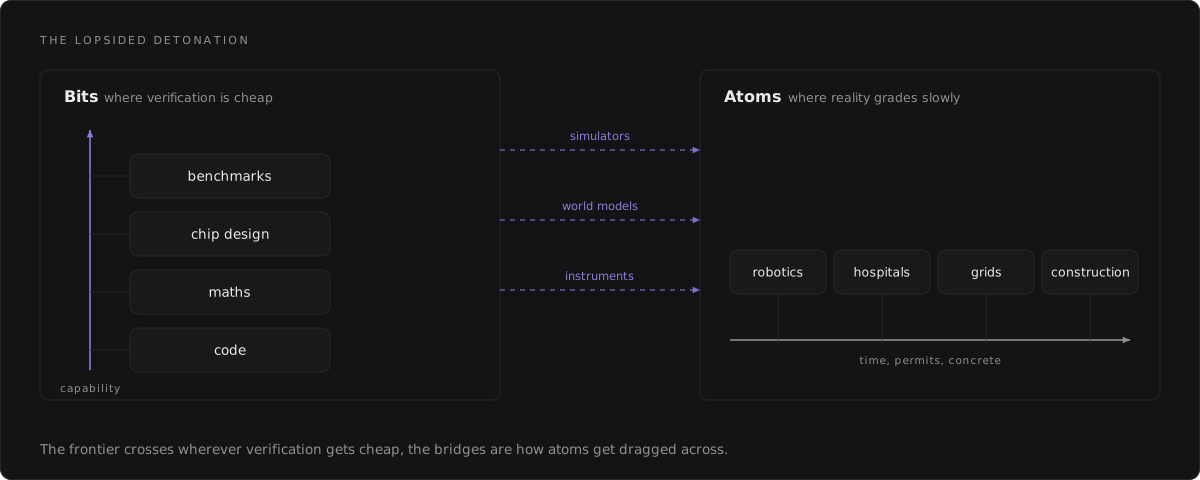
So the future refuses both of its popular shapes. Not a wall, and not a uniform take-off. A lopsided detonation.
Everything on the verifiable side of the line is going vertical, or already has. Mathematics, software, algorithms, chip design, and AI research itself, which is, inconveniently for the modest, mostly code plus experiments that run on the very compute everyone is fighting over. The length of tasks autonomous agents can complete has been doubling every few months and accelerating. Release cycles that took a year now take weeks. A snake has tasted its own tail and found it nutritious.
Everything on the other side grinds. Robotics has finally broken its forty-year curse, the perception problem that kept it perpetually five years away is genuinely cracking, and it still dies where it has always died, in the long tail of unstructured contact, friction, deformable objects, the stuff that neither simulates well nor forgives. Biology moves at incubation speed. Power moves at concrete speed. Explosion in bits, grind in atoms.
But the grind is not static, and this is the part both camps miss. The explosive side keeps forging the tools that drag domains across the line: richer simulators, world models that learn physics from the million falls, robot hands to run the experiments that close the causal loops. The atoms side is being eaten from the edge inward. The only question is whether it gets eaten before the electrons run short or the capital runs scared.
The last human job
In the middle of all this stands an odd figure: the human the process still needs. The automation frontier eats verification-cheap work first, which is why the junior analyst and the boilerplate coder are already gone. What it cannot yet eat is verification itself in the domains too fuzzy to formalise: taste, judgement, the trained gut that reads a fluent, confident, beautifully formatted output and knows it is bullshit. Research was always heavy-tailed, and these tools amplify the top of the distribution far more than the middle, because extracting real value from a system that will generate anything requires exactly the discrimination the middle never had. One obsessive with a calibrated detector and a fleet of models now outproduces a floor of professionals who clock off at five, not because the obsessive works harder, though they do, but because their scarce input is no longer knowledge or even intelligence. It is knowing which generated thing is gold.
This is not a comforting parable about human relevance. It is a map of the frontier. The last human job is being the verifier in the places where no verifier can be built. For now.
The same speed
And here the optimists' own machinery turns around and bites them. The entire case for the explosion rests on the loop: AI improving AI, output compounding into input, the property no railway ever had. The entire case for the tail, the small probability of the irreversibly bad thing, rests on the same loop: a system improving faster than its improvements can be checked. You do not get to have it both ways. A loop fast enough to tunnel through every wall in this essay and slow enough to remain steerable is a contradiction, because those are the same speed. Which is why alignment is not an ethics annex bolted onto the capability question. It is a capability bottleneck wearing a safety hat: an AI researcher you cannot trust is one you have to throttle, and a throttled loop is a slowed one. The paper assumes the problem "solved to a sufficient degree" and moves on, one quiet sentence carrying more load than all six of its walls combined.
Strip everything else away and the whole debate compresses to two numbers. The size of the non-simulatable residual: how much of consequence lives beyond the reach of any verifier or world model we can build in time. And the size of the irreversible tail: how much probability sits on outcomes nobody gets to correct. Every argument above is, underneath, a fight over those two numbers, and neither is measurable from where we stand, because both reveal themselves only during the onset. Which is where we are standing. The accelerationist bet, held honestly, is not "there are no walls". It is "the walls are all made of atoms, and the bits will tunnel through them before they bite". That is a real bet, and quite possibly a good one. What it is not, is a sure thing.
Write versus convince
One wall goes unmentioned in the paper, and it is the one you are using to read this. The brain is the original unsimulated substrate. We can read it, crudely, a few thousand electrodes eavesdropping on a hundred trillion synapses, and we can barely write to it at all. Full-dive virtual reality and the end of ageing turn out to be, at the right level of description, the same problem: a system we can observe but not yet edit. Everything outside the skull is engineering now, actuators and optics and latency, all buildable. Inside remains the last domain that has not crossed the line.
Which is perhaps why that opening address is the detail I keep returning to. Every technique civilisation has ever devised for changing a mind, argument, story, evidence, patience, exists because minds cannot be written to directly. They can only be convinced. The paper spoke to its machine readers politely, and the one I set loose on it did not simply follow the script: it summarised, then argued, and was argued with in return, turn after turn, human and model grading each other's outputs like the world's strangest peer review. If there is a future worth wanting anywhere in this, it looks like that. Not minds we can write to. Minds we have to convince.
Everything else, you build.
Prefer the full experience? Read this essay in the house. Machine-readable: markdown source.